
soundproofing specialist vs general contractor
- 5 days ago
- 6 min read
Soundproofing Specialist vs General Contractor: The Difference That Decides Whether Your Money Works
When you start looking into soundproofing your home, office or venue, you will quickly find two kinds of companies offering to do the work. The first is a soundproofing specialist. The second is a general contractor offering soundproofing as an add on while they are already on site doing something else. On a quote, the two can look surprisingly similar. In the finished result, they are worlds apart. This post explains the difference between a soundproofing specialist vs general contractor, why it matters more than most people realise, and how to tell which one you are actually talking to before any money changes hands.

The Difference Is Specialism Itself
The difference being, sound and combating noise are our specialist subjects. That is not a slogan, it is the whole point. We know how sound travels and how to reduce noise transfer through walls, floors and ceilings, and that knowledge is the product. The materials are secondary. We have been helping many homeowners, business owners, schools, museums, restaurants, bars and many more to reduce the effects of noise transfer, investing in their quiet future.
A general contractor is a very different proposition. General contractors are good at building things. Extensions, kitchens, loft conversions, office fit outs. The work is broad, and most good ones are genuinely skilled at it. But general building work and acoustic work are not the same trade, and the gap between them is where most soundproofing jobs go wrong.
The "While We Are On Site" Problem
General contractors often offer soundproofing noise reduction services whilst on site carrying out other works, by simply adding sound products, but it takes much more than that to get the very best results, something we are very proud of attaining for our clients.
This pattern is worth understanding properly, because it is how most of the disappointing jobs we get called in to fix actually happened. A homeowner is having a loft conversion, an extension or a renovation. The builder says, "We can sort the noise while we are here, we will put some insulation in the floor and add a second board to the wall." The price seems reasonable, the timing is convenient, and the offer is made with genuine good intentions. Six months later, the client can still hear everything, and the money has been spent.
The problem is not that the builder did a sloppy job of the building work. The problem is that "add some sound products" is not how soundproofing works. Acoustic performance comes from how a system is designed and installed as a whole, not from which individual materials happen to be in the wall. Slapping an extra layer of plasterboard onto a wall that is rigidly connected to the structure, or dropping mineral wool into a floor void without decoupling the floor surface, produces almost no measurable improvement. It looks like soundproofing. It performs like decoration.
What a Specialist Actually Does Differently
Everything we install at Pinnacle Sound is built around four acoustic principles, and they all have to be present for the system to perform. Decoupling, absorption, mass and damping. We ensure everything is isolated, independent and decoupled from the existing structure, gaining excellent results for our clients time and time again.
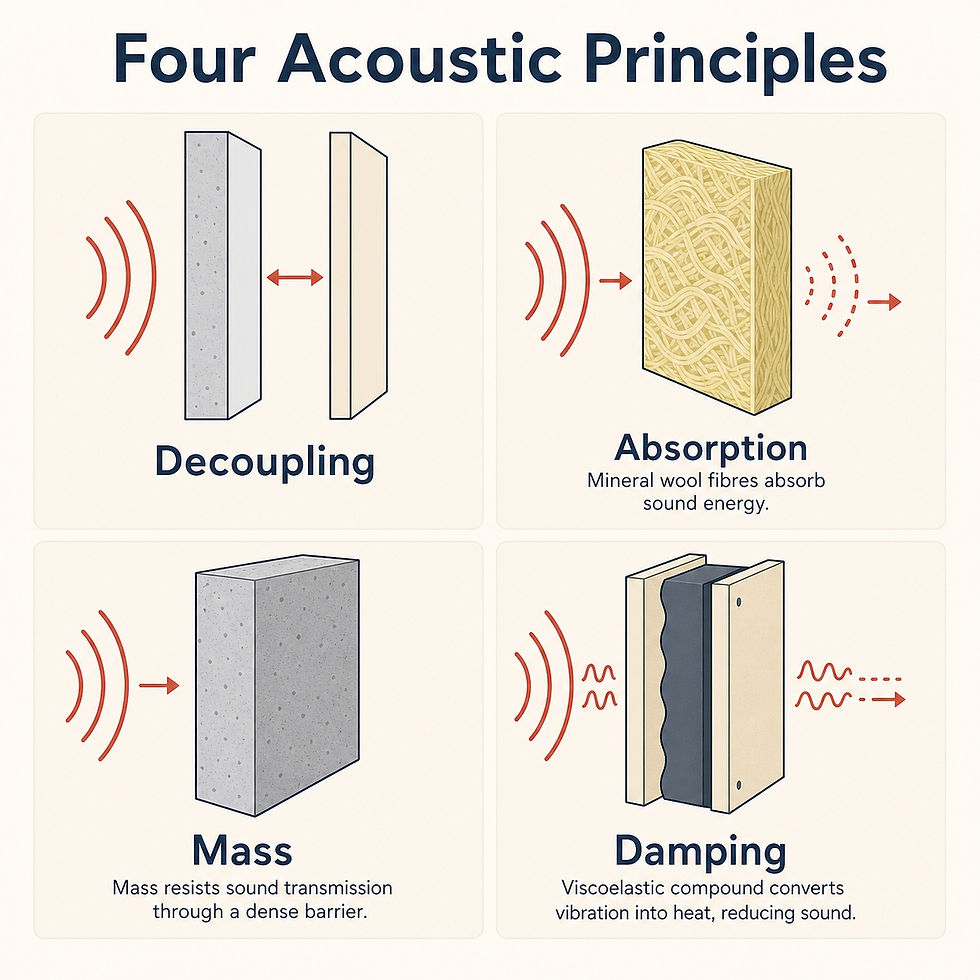
In practice, that means ceilings and walls built on Genie Clip systems rather than resilient bars or direct fixings. It means Rockwool RW3 fully insulating the framework voids rather than a token layer of whatever insulation happened to be on the van. It means 19mm Soundplank and 12.5mm Soundbloc acoustic plasterboard providing the mass, with Tecsound membrane providing the damping between them. It means acoustic perimeter flanking bands and acoustic sealant closing every edge, because a single unsealed perimeter can leak more sound than the rest of the wall stops. It means multi layer acoustic flooring boards with Rockwool and Tecsound on floor jobs.
None of that is exotic or mysterious. It is simply a specialist methodology applied consistently. The reason it works is the same reason specialist trades work everywhere. The person doing the job has done this exact job, many times, and knows where it goes wrong.
The Survey Is Where the Money Is Made or Lost
The single biggest difference between a specialist and a general contractor happens before any tools come out. It is the survey.
When we carry out our surveys we discuss and explain every step of the process, managing expectations. We ask what you can hear, when you hear it, and where in the room it is loudest. We identify whether the noise is airborne or impact, because they need different treatments. We look for flanking paths, the hidden routes sound takes around a treated surface through floors, ceilings, sockets, junctions and adjoining walls. We work out whether the dot and dab plasterboard on your party wall is creating a drum effect, and whether the joists running into next door are carrying the noise around the wall entirely.
Only after that do we specify a system. The specification fits the diagnosis. A general contractor typically skips this stage completely, because it requires equipment, training and time that sit outside the normal building workflow. The result is a generic fix applied to a specific problem, and generic fixes to specific problems rarely work.
Honest About What Is Possible
One more thing separates a specialist from a general contractor, and it is the thing clients often find most surprising. We are always honest and realistic in what is possible, as absolute silence is not achievable.
That is the truth of acoustics, and anyone who promises you total silence is either mistaken or selling you something. Sound is energy, and in a connected building some of it will always find a path. What a properly designed and installed system delivers is a dramatic reduction, the kind where clients tell us they can no longer tell when the neighbours are home. Managing expectations properly means telling you, before we start, what result your specific property can realistically achieve and what it will cost to get there. Some contractors will tell you what you want to hear. We would rather tell you what is true, because you will be living with the result long after we have left.
What the Difference Looks Like in Real Jobs
The clearest way to show the difference is in the work itself. We have built music studios in semi detached homes, where the brief was to contain a drum kit inside a room sitting a few metres from the neighbours' bedrooms, and where a general approach would have guaranteed a planning dispute. We have upgraded party walls bringing back the calm in homes where the owners had stopped using rooms because of what came through the wall. We have converted garden rooms into practice rooms for musicians whose families wanted their evenings back.
Each of those jobs succeeded because the diagnosis came first, the system was designed for the specific building, and the installation was carried out by people who install these systems every week. A general contractor, however capable at general building, would have been guessing at every one of those steps.
How to Tell Which One You Are Talking To
If you are comparing quotes and want to work out whether you are dealing with a soundproofing specialist vs general contractor, a few questions will tell you quickly. Ask what survey or diagnosis they will carry out before specifying the work. Ask which specific products they install and why they chose them. Ask how they treat flanking paths and perimeter sealing. Ask what result they expect to achieve, and watch carefully whether the answer includes an honest conversation about limitations.
A specialist will have confident, specific answers to all of these. A general contractor offering soundproofing as a sideline will tend to talk about products rather than systems, and will rarely mention flanking at all.
If We Can Assist You
If we can assist you with any sound or noise issues, we would be happy to provide you with the best advice. Whether your project is a single party wall, a full studio build, a restaurant that needs to keep its neighbours happy, or a workspace where confidential conversations need to stay confidential, the first step is the same. We visit, we listen to what you are dealing with, we survey the property properly, and we give you an honest specification with honest expectations attached.
You only want to pay for this once. Getting it done by a specialist is how you make sure once is enough.

Contact Pinnacle Sound for a survey and a straight, realistic answer about your noise problem.


Comments