
Soundproofing for Airbnb and Holiday Lets: Why One Noise Complaint Can Cost You More Than a Bad Review

A single noise complaint rarely arrives alone. It starts with a knock from a neighbour, or a message through Airbnb's Neighbourhood Support tool, and it usually ends somewhere worse: a one-star review mentioning "thin walls" or "could hear everything," a warning letter from the council, or in persistent cases, a Community Protection Notice. For a host, that chain of events can undo months of five-star bookings in a single weekend.
If your holiday let has ever had a noise complaint, whether from a neighbour, a guest, or the council, you are not dealing with a one-off nuisance. You are dealing with a structural problem, and structural problems need a structural solution. This is where soundproofing for Airbnb and holiday lets stops being a nice-to-have and becomes part of protecting the business itself.
Why SOUNDPROOFING FOR AIRBNB AND holiday lets attract noise complaints more than long-term tenancies

A permanent resident learns the rhythm of a building. They know which floorboard creaks, which wall carries sound to the flat next door, and they adjust without thinking about it. A holiday guest has none of that context. They arrive for two or three nights, often in a group, sometimes celebrating something, and they have no long-term relationship with the neighbours on the other side of the wall to protect.
Add late check-outs, early check-ins, suitcases wheeled across hard flooring, and the simple fact that most short-term guests are more relaxed about volume than they would be in their own home, and the pattern becomes clear. It is rarely one bad guest. It is a building that was never built, or converted, with sound transmission in mind, now being used in a way that exposes exactly that weakness.
Terraced houses, converted flats, and buildings with dot-and-dab plasterboard party walls are particularly prone to this. The gap behind dot-and-dab plasterboard acts like the inside of a drum, carrying voices, footsteps and music straight through to the next-door property with very little resistance. A guest speaking at a normal volume in one of these buildings can sound, from the other side of the wall, as though they are in the same room as the neighbour.
What actually happens when a complaint is made
In England, a council's environmental health team can act on a noise complaint from a holiday let in the same way they would for any residential nuisance. That typically starts with a warning, but persistent or serious noise can lead to a Community Protection Notice, and non-compliance with that can bring a fine. For hosts operating in London, there is also the added complexity of the 90-night short-term letting cap, and further afield, some local authorities are introducing registration requirements for short-term lets, meaning a property with a track record of noise complaints could face closer scrutiny than one without.
Airbnb itself takes repeated neighbour complaints seriously too. Its Neighbourhood Support tool lets anyone report a nearby listing directly to the platform, and a pattern of upheld complaints can affect a host's standing on the platform, independently of anything a council decides to do.
None of this is to alarm hosts unnecessarily. Most noise issues never escalate that far. But the pattern is consistent: a complaint that gets addressed properly and quickly rarely repeats, while a complaint that gets managed with a polite email and a hopeful shrug tends to come back, often worse, on the next busy weekend.
Why house rules and earplugs are not a soundproofing strategy
Most hosts' first response to a noise complaint is behavioural: a house rule about quiet hours, a laminated note by the door, perhaps a basket of earplugs left out for guests who mention noise from outside. These are sensible things to have, and worth keeping, but they manage guest behaviour. They do nothing for the sound that is already travelling through the building structure itself, footsteps through a ceiling, voices through a party wall, a television through a dot-and-dab partition. No house rule stops a footstep from transmitting through an untreated floor.
This is the gap that catches so many hosts out. The complaint isn't really about a loud guest. It's about a building that has no acoustic separation between the space being let and the space next door or below, and that only becomes visible once the property starts being used more intensively than it was before.
What proper soundproofing for a holiday let actually involves
Treating a holiday let is not fundamentally different from treating any other residential space with a party wall or ceiling problem, but the priorities shift slightly. Hosts need a solution that holds up under frequent turnover, doesn't reduce the usable floor area or ceiling height too drastically, and addresses the specific rooms guests actually use loudly: living areas, bedrooms directly above a neighbour, and any party wall shared with an adjoining property.
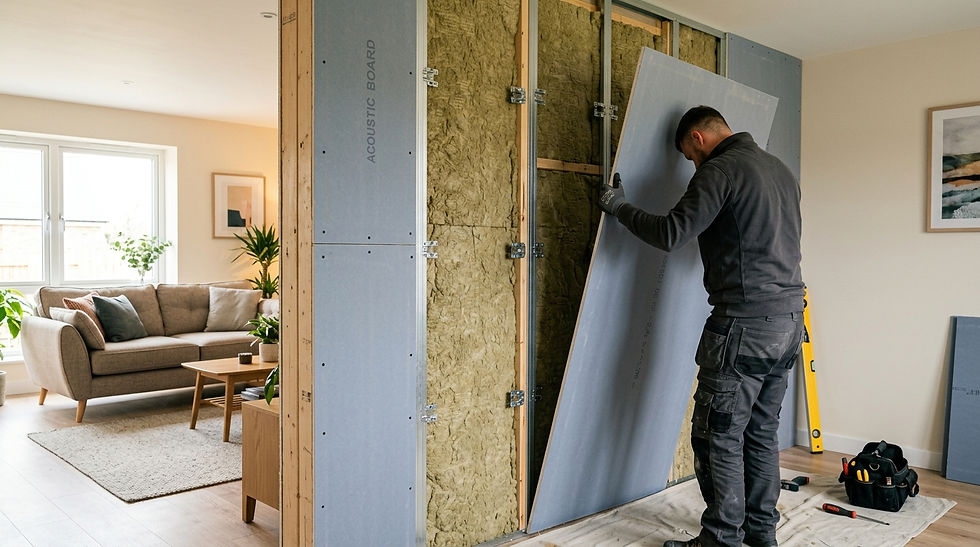
For walls and ceilings, our approach uses a Genie Clip system to fully decouple the new acoustic layer from the existing structure, rather than simply adding mass on top of a wall that is still free to vibrate. The void is fully insulated with Rockwool RW3 for both sound absorption and thermal performance, useful in a property that needs to stay comfortable for guests year-round. Over that goes a layer of 19 mm Soundplank acoustic plasterboard, a Tecsound acoustic membrane, and a final layer of 12.5 mm Soundbloc plasterboard with tight, staggered joints to keep the whole system decoupled. Every perimeter and joint is sealed with acoustic sealant before the finish is plastered and skimmed, because sound will find the smallest untreated gap and use it.
For ceilings specifically, where footfall noise from an upstairs let is the usual complaint, the same principle of full decoupling matters more than mass alone. Thicker carpet or extra plasterboard slapped onto an existing ceiling rarely solves impact noise, because the vibration is still travelling through a structure that is rigidly connected to the room below.
Treating it as protecting a business, not just a property
A holiday let generates income precisely because it attracts a constant flow of new guests. That same flow is what exposes any acoustic weakness in the building faster and more visibly than a single long-term tenant ever would. Treating the noise issue properly protects the reviews, protects the relationship with neighbours who might otherwise report every gathering to the council, and protects the licence to keep operating at all in areas where registration and enforcement are becoming stricter.
We would be glad to carry out a no-obligation acoustic assessment of a holiday let that has had a complaint, or one you'd simply rather get ahead of before it becomes a problem. One of our specialists would visit, identify exactly where sound is escaping, whether through a party wall, a ceiling, or gaps around doors and sockets, and set out clearly what could be done and roughly what it would cost, with no pressure and no jargon.
If a noise complaint has already landed on your holiday let, or you would rather deal with the risk before a guest does, we would welcome the chance to help.


Comments