
Soundproofing a Ceiling From Footfall Noise: Why the Flat Above Sounds So Loud (and What Actually Works)

Of all the noise complaints we deal with at Pinnacle Sound, footfall from the flat above is the most common by a mile. It is the noise that gets described most often as "unbearable", the one that gets people writing to their MP, and the one that most often makes homeowners consider selling up. It is also one of the most misunderstood, which is why so many people spend money on solutions that do very little. This post explains why footfall carries the way it does, why the usual DIY fixes rarely work, and what soundproofing a ceiling from footfall noise actually involves when it is done properly.
Why Footfall Sounds So Much Louder Than It Should
Footsteps in the flat above always sound worse than they seem like they should. There is a reason for that, and it is not because the neighbours are being deliberately heavy footed. When somebody walks on a floor, their heel strikes the floor surface and sends a physical vibration directly into the structure of the building. That vibration then travels through the joists or the concrete slab, into the walls of your flat, and radiates into your room as sound.
This is called impact noise, and it behaves very differently to airborne noise like voices or television. Airborne noise has to travel through the air, hit a surface, vibrate it, and then travel through the air on the other side. Impact noise skips that first stage completely. The energy is already in the structure the moment the foot lands. That is why footsteps can feel like they are happening inside your ceiling rather than above it. Acoustically, they nearly are.
Understanding this distinction is the single most important thing to grasp before spending any money on a solution. Almost every failed DIY attempt at soundproofing a ceiling from footfall noise fails for the same reason. It tries to solve an impact noise problem with an airborne noise fix.
Why the Common DIY Fixes Do Not Work
Homeowners typically try a few things before they call us. It is worth explaining why each of them tends to disappoint, so you do not spend the money before you have understood what you are actually dealing with.
Thicker carpets and underlay in the flat above. In principle this should help, and to be fair, a proper acoustic underlay does reduce footfall to some degree. In practice, most upstairs neighbours will not lift their flooring to install one, and even if they do, the improvement is often modest because the vibration is still going into the joists or slab regardless of what is on top.
Acoustic foam tiles on the ceiling. This is probably the single most common mistake we see. Egg crate foam and decorative acoustic panels are designed to absorb sound reflections inside a room. They do very little for impact noise coming through the ceiling from above. Sticking them on the underside of your ceiling looks like a solution and sounds like nothing.
A second layer of plasterboard screwed directly onto the existing ceiling. Adding mass alone helps a little with airborne noise, but because the new plasterboard is rigidly connected to the same joists that are already carrying the vibration, the impact noise passes straight through. All you have really done is make the ceiling heavier.
Rugs, curtains and soft furnishings in your own flat. These reduce reverberation within your room but do not stop noise entering from above at all. If anything, they make the footfall stand out more once the general room noise is reduced.
None of these approaches are wrong in a general sense. They are just aimed at the wrong problem.
What Soundproofing a Ceiling From Footfall Noise Actually Involves
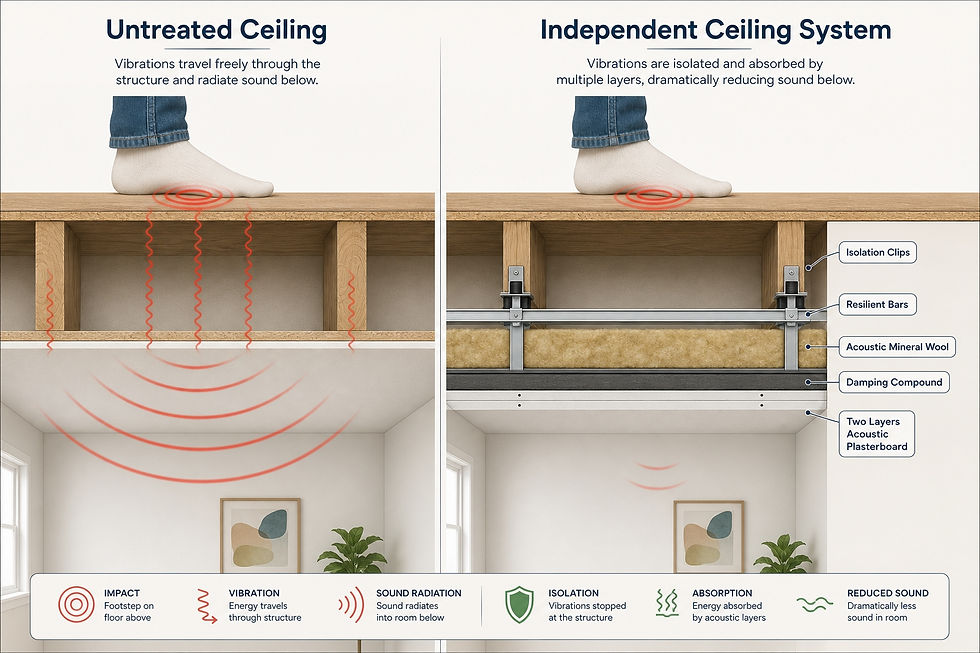
Doing the job properly means treating the ceiling as a system, not as a surface. Four principles need to be working together.
The first is decoupling. The new ceiling has to be physically separated from the structure that is carrying the vibration. This is usually achieved with resilient bars, isolation clips or a fully independent joist system, depending on how much depth you have to work with. The point is that the finish surface you look at is no longer rigidly connected to the joists above. Vibration hits the isolation layer and stops.
The second is mass. Once the ceiling is decoupled, adding significant mass (typically two layers of high density acoustic plasterboard) gives the sound waves something dense to work against. Mass alone is not enough, but mass without decoupling is even less use.
The third is damping. A damping compound applied between the plasterboard layers turns sound energy into a very small amount of heat, killing the resonance that would otherwise let the ceiling vibrate like a drum.
The fourth is absorption within the cavity. Filling the space between the joists with an appropriate acoustic mineral wool absorbs the sound energy that would otherwise resonate inside that void.
The four together are what makes the difference. Skip any one of them and the result underperforms. This is why soundproofing a ceiling from footfall noise is genuinely more involved than the marketing brochures for individual products suggest. There is no single miracle material. There is a system that works when it is applied properly.
Flanking Paths: The Reason Some Ceiling Jobs Still Disappoint
Even a properly built independent ceiling can underperform if the flanking paths have not been considered. Sound is energy and energy will always take the easiest route. If the ceiling is now heavily treated but the vibration can still travel down the party walls, into the floor structure, and back up into your room from the side, you will still hear more than you expected.
This is where experience makes a real difference. On a proper survey we look at the whole three dimensional path of the noise, not just the surface you are staring at when the neighbour is walking around. Sometimes the ceiling needs partial treatment plus wall treatment at the head of the wall. Sometimes the fix is a fully independent ceiling that stops short of the party walls, with a soft junction sealed acoustically. Sometimes the noise is genuinely coming down the wall, not through the ceiling, and the ceiling work would not have solved it on its own.
Getting the diagnosis right before the works start is what separates a job that transforms the flat from a job that spends the same money for a fraction of the improvement.
The Loss of Ceiling Height (and Why It Is Worth It)
The one honest downside of soundproofing a ceiling from footfall noise is that you lose some ceiling height. A well designed independent ceiling system typically takes between 60mm and 150mm off the room, depending on the isolation method and how bad the incoming noise is. In flats with 2.4m ceilings that is a real consideration, and something we always discuss with clients up front.
Most homeowners, once they have lived with the noise for long enough, decide the trade off is worthwhile. A slightly lower ceiling in a room you can actually relax in is a very different proposition to a full height ceiling in a room you have started to dread being in. That is a conversation only you can have, and we will always give you the honest numbers so you can make it properly.
What to Expect From a Proper Job

A typical ceiling treatment on a two bedroom flat takes anywhere from a week to three weeks depending on the size, the isolation system chosen, and whether the flanking paths need addressing at the same time. It is disruptive work while it is being done. The room is out of use, there is dust, and there is a clear before and after point where you are not sleeping in the treated room.
What you get at the end of it is a genuine reduction in impact noise, not the polite marketing sort. Clients regularly tell us that they can no longer tell when the neighbour is home. That is what a properly executed system delivers when the diagnosis is right and the installation is done by people who understand what they are doing.
Talk to Us Before You Spend
If footfall from the flat above is affecting your sleep, your concentration or your enjoyment of your own home, do not spend money on tiles and foam that will not fix it. Get somebody in who can look at the actual construction, identify the real routes the sound is taking, and specify a system that will work.
We will visit the property, listen to what you are dealing with, and give you an honest answer about what soundproofing a ceiling from footfall noise will require and what it will cost. Sometimes the answer is a full independent ceiling. Sometimes it is a smaller intervention. Either way, you will spend the budget you have on the fix that actually works.
Contact Pinnacle Sound to arrange a site visit and an honest assessment of your footfall noise problem.


Comments