
Office Acoustics Done Right: Why the Wrong Design Is Costing You Productivity (And How a Soundproofing Company Fixes It)
Walk into most modern offices and you'll notice the same thing within seconds. Glass meeting rooms, exposed ceilings, polished concrete floors, hard desks, and open-plan layouts as far as the eye can see. It looks sharp in the architect's render. It photographs beautifully for the company website.
And acoustically, it's often a disaster.
Most offices get acoustics completely wrong, and businesses pay the price in three very measurable ways: lost productivity, poor speech privacy, and declining staff wellbeing. The good news is that it's entirely fixable, and on a recent commercial fit-out we did exactly that. In this post, we'll walk you through what goes wrong in typical office design, what a professional soundproofing company does differently, and share real images from a finished office acoustics project.
Why Office Acoustics Are Almost Always an Afterthought
Acoustics in commercial spaces tend to get treated as a nice-to-have right at the end of a project, squeezed in after the budget has been spent on furniture, branding, and tech. By that point, the damage is already done. Hard, reflective surfaces have been specified everywhere. Open-plan seating has been signed off. All-glass meeting rooms have been fitted.
The result is a workspace that looks great but sounds awful:
Conversations carry across the entire floor, killing focus
Video calls bleed out of meeting rooms and into desks nearby
Echo and reverberation build up, making people raise their voices
Sensitive conversations can be overheard from two rooms away
Staff report headaches, fatigue and stress by mid-afternoon
Studies repeatedly show that noise is the single biggest complaint in open-plan offices, and that poor acoustics can reduce cognitive task performance by up to 66%. When you put that in real terms, you're paying full salaries for people who are working at two-thirds capacity because of the environment they're sitting in.
This is exactly where the right soundproofing company earns its keep. Not by selling you a single product, but by redesigning the acoustic behaviour of the entire space.
The Three Biggest Office Acoustic Mistakes
Before we get into the fix, it's worth understanding what goes wrong in the first place. These are the three issues we see on almost every commercial site visit.
1. Treating Acoustic Ceilings as a Design Element
Suspended ceiling tiles are often chosen for their look, not their performance. Standard mineral tiles offer some absorption, but they're rarely specified with the right NRC (Noise Reduction Coefficient) or CAC (Ceiling Attenuation Class) rating for the space they're in. A high-traffic open-plan office needs a completely different acoustic ceiling than a quiet private office, and one-size-fits-all specifications fail both.
2. All-Glass Meeting Rooms with No Acoustic Seal
Glass partitions look modern and let in natural light, but glass is a highly reflective surface on the inside and only a moderate sound barrier on its own. Worse, meeting rooms are often fitted with single-glazed partitions, standard doors, and no acoustic seals around the frame. Confidential conversations leak straight out through the weakest point, usually the door gap or the ceiling void above the partition.
3. Ignoring the Plenum (The Space Above the Ceiling)
Here's the hidden killer. In most commercial buildings, partition walls only go up as far as the suspended ceiling, not all the way to the structural slab above. That means sound from one meeting room simply travels up, over the top of the wall, through the shared ceiling void (the plenum), and back down into the next room or open-plan area. You can have the most beautifully sealed door in the world, and it won't matter.
The Professional Fix: A Layered Approach to Office Acoustics
Good acoustics isn't about a single product. It's about a layered approach combining three core functions, and a proper soundproofing company will design all three together from day one.
Block
Stop sound from crossing between zones. In practice, that means full-height partitions where privacy matters, acoustic plasterboard build-ups, and properly detailed junctions where walls meet ceilings and floors. Where full-height isn't possible, we use acoustic barriers within the ceiling plenum to cut off that hidden flanking path.
Absorb
Reduce echo and reverberation within each space. This is where high-performance acoustic ceiling tiles, wall-mounted absorbers, baffles, and rafts come in. The right absorption brings reverberation times down into comfortable ranges (typically 0.4 to 0.6 seconds for offices), which makes conversation easier, video calls clearer, and the whole space feel calmer.
Control
Manage how sound behaves across the whole floorplate. This can include sound masking systems, zoning quiet areas away from collaborative areas, specifying softer finishes underfoot, and even the positioning of desks and breakout spaces. Control is where acoustic design meets workplace strategy, and it's often the most overlooked piece.
When these three layers are designed together, the difference is immediate. Staff walk into the finished space and genuinely comment that it feels different. Calmer. More focused. Easier to hold a conversation without shouting, and easier to concentrate without headphones welded to your head.
Case Study: A Recent Commercial Office Acoustics Project
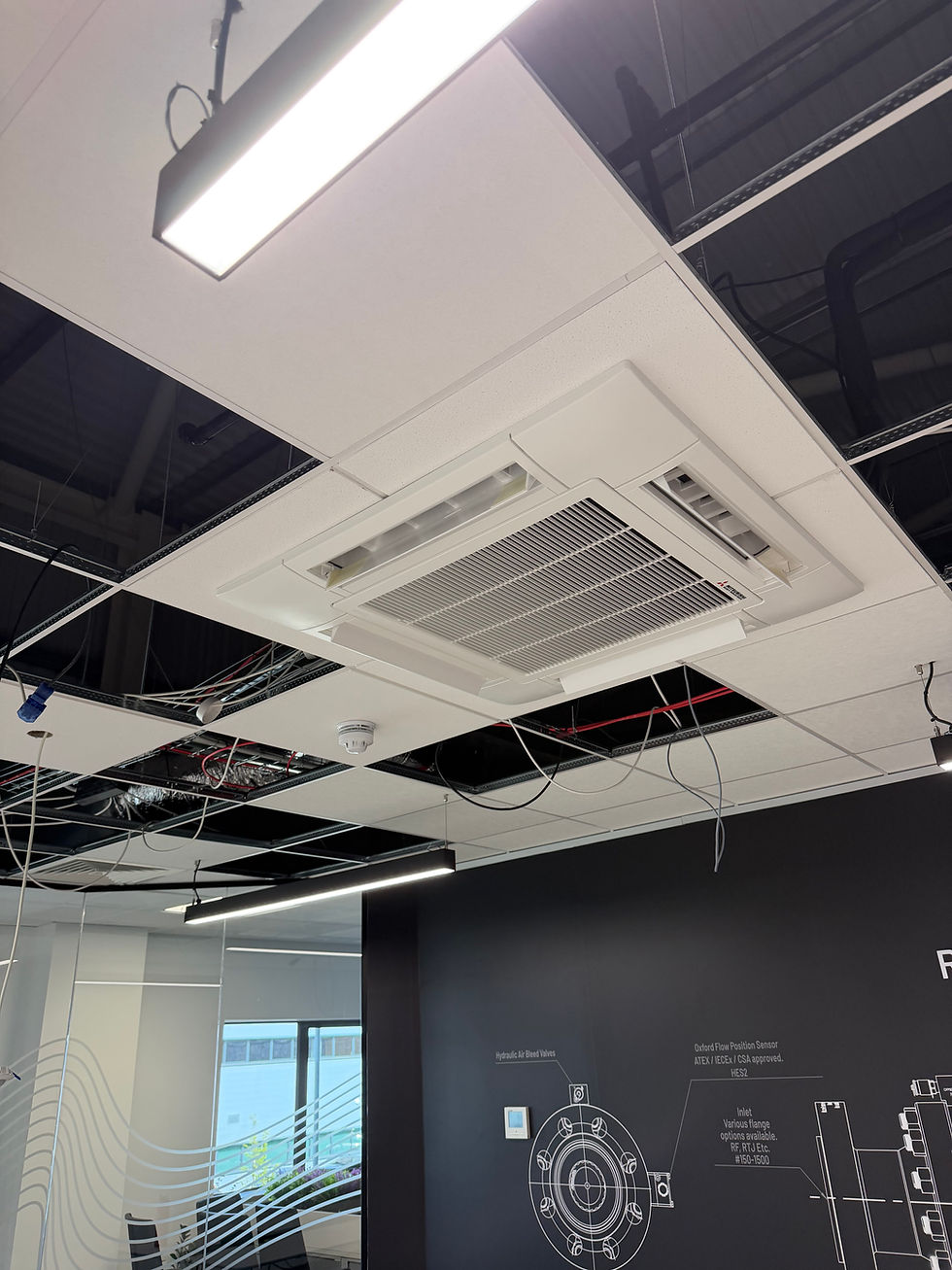
On this recent project, the client had a newly fitted-out office and meeting room space with all the modern design cues you'd expect. Exposed services, glass partitioning, an open boardroom, and integrated branding on the feature wall. On paper it ticked every box. In use, the team were struggling with echo in the boardroom, poor speech privacy between zones, and general noise bleed across the floor.
Our scope as the soundproofing company on the project included:
Installing a high-performance acoustic suspended ceiling using tiles specifically rated for both absorption (NRC) and attenuation (CAC), so sound is absorbed inside each room AND stopped from crossing over the top of partition walls
Integrating services cleanly into the ceiling grid, including cassette air conditioning units, linear LED lighting, smoke detectors and sprinklers, without compromising acoustic performance
Adding plenum barriers above partition walls to close off the shared ceiling void between meeting rooms and open-plan areas
Detailing the junctions between walls, ceilings and glazing to eliminate flanking paths
Coordinating with the M&E contractor so that ductwork and cabling didn't create new acoustic leaks

The finished result is a workspace that looks every bit as sharp as the original design intent, but now performs acoustically as well. Meeting rooms hold their privacy. The boardroom no longer echoes. Open-plan conversation stays within its zone instead of bouncing across the entire floor.

What to Look For When Choosing a Soundproofing Company for Your Office
Not every contractor is set up to deliver commercial acoustic work to this standard. If you're fitting out a new space, refurbishing an existing one, or retrofitting to fix acoustic problems that have crept in, these are the questions worth asking:
Will they carry out an acoustic assessment before quoting, including reverberation measurements where relevant?
Can they specify ceiling tiles by NRC and CAC values, not just by appearance?
Do they understand and treat the ceiling plenum as part of the design?
Can they coordinate with M&E, partitions and main contractors on a live site?
Do they offer clear advice on speech privacy, reverberation control and sound masking as separate but connected issues?
Can they share finished project case studies and references from similar commercial fit-outs?
A soundproofing company that answers yes to all of the above will save you money twice. Once on the install, because the design is right first time, and again every month afterwards in the form of a team that can actually concentrate, communicate and work.
FAQ: Office Acoustics and Commercial Soundproofing
Q: How do I know if my office has an acoustics problem?
A: The usual signs are staff wearing headphones all day, complaints about echo in meeting rooms, video calls being hard to understand, and confidential conversations being overheard. If any of those sound familiar, the space almost certainly needs acoustic treatment.
Q: Can you improve the acoustics of an existing office without a full refit?
A: Yes. Retrofitting acoustic ceiling tiles, wall absorbers, plenum barriers above partitions, and door seals can transform an existing space with minimal disruption. We often carry out this kind of work in the evenings or over weekends to avoid impacting business.
Q: How much does commercial office soundproofing cost?
A: It varies widely depending on the floor area, the level of privacy required, and whether the work is new-build or retrofit. The important number to focus on isn't the install cost, it's the productivity cost of doing nothing. Most offices recover the investment quickly through better staff focus and retention.
Q: Do we really need full-height partitions in every meeting room?
A: Not every room needs the same level of privacy. A quick-sync room and a confidential HR office have very different requirements. A good soundproofing company will zone the building and specify each room appropriately, which usually saves money compared to over-engineering everything.
Q: Will acoustic treatment make the office look worse?
A: No. Modern acoustic ceilings, baffles, rafts and wall panels come in a huge range of finishes, colours and formats. On most of our commercial projects, the acoustic elements actively enhance the design rather than compromising it.
Ready to Fix Your Office Acoustics Properly?
If your team is struggling with noise, echo, or a lack of speech privacy, it's not something you have to live with, and it's not something that can be fixed by scattering a few foam panels around the walls. The offices that feel great to work in have been designed acoustically from the ceiling down, with blocking, absorption and control all working together.
As a specialist commercial soundproofing company, we handle everything from full acoustic ceiling installations and partition detailing to retrofit treatments for offices already in use. Get in touch for a free site visit and we'll show you exactly where your current space is losing performance and how to get it back.
Call us today or request a free acoustic assessment online, and give your team the workspace they actually deserve.


Comments